
Wheat Penny Value by Year: Full 1909-1958 Price Chart
See wheat penny values by year and era from 1909 to 1958, including what a 1944 wheat penny is worth, the real key dates, and which years are common.
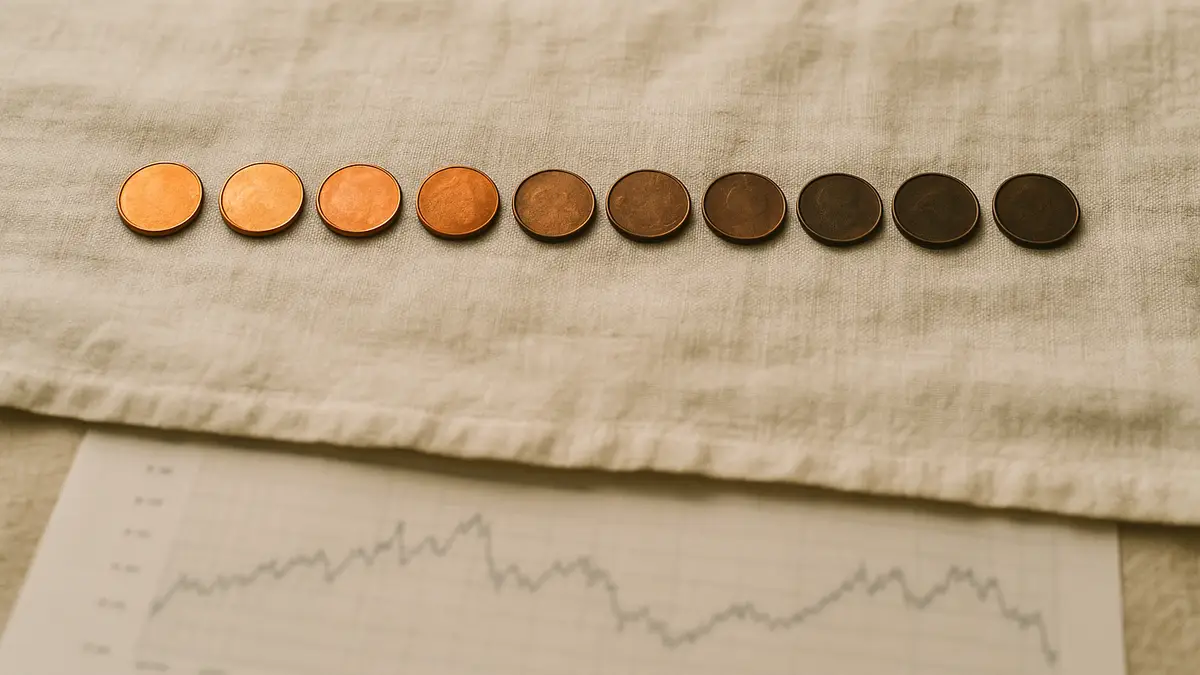
Fifty years of wheat pennies were struck between 1909 and 1958, and most of them are worth close to the same modest amount. This chart groups the series into eras so you can place any date you find without hunting through a year-by-year list that mostly repeats itself.
Is a wheat penny worth money just because it is old?
Not by itself. Value comes from mintage numbers, not age: a year where the mint struck hundreds of millions of cents stays common no matter how many decades pass, while a year with a genuinely low mintage stays scarce. Condition adds another layer on top, since a worn common date and an uncirculated common date from the same year can differ by ten times or more even though they share a mintmark and year.
What is a wheat penny worth by year and era?
| Years | What’s notable | Typical circulated value | Typical uncirculated (red) value |
|---|---|---|---|
| 1909 (P, S) | First year of the design | $1-$5 | $10-$40+ |
| 1909-S VDB | Key date, designer’s initials, low mintage | $700-$1,200+ | Several thousand+ |
| 1910-1920 | Common, except scattered lower-mintage branch strikes | $0.10-$0.50 | $2-$10 |
| 1914-D | Key date | $150-$300+ | $1,000+ |
| 1921-1930 | Common, generally available | $0.10-$0.30 | $2-$8 |
| 1922 no D | Key date, weak-die Denver strikes | $500-$800+ | Rare in uncirculated |
| 1931-S | Key date, low mintage | $75-$150 | $300-$500+ |
| 1932-1942 | Common, Depression-era mintages steady | $0.05-$0.25 | $1-$5 |
| 1943 (steel) | Zinc-coated steel, common; rare bronze error exists | $0.10-$0.50 | $2-$5 |
| 1944-1946 | Common, shell-case brass composition | $0.05-$0.15 | $1-$3 |
| 1947-1958 | Common; 1955 doubled die is a notable exception | $0.03-$0.10 | $1-$3 |
These are collector-market ranges, not investment advice, and they assume a coin free of damage, cleaning, or corrosion. A coin in worse condition than described sells below its range; a coin certified by a grading service can sell above it.
What is a 1944 wheat penny worth specifically?
1944 sits solidly in the common range. All three mints, Philadelphia, Denver, and San Francisco, struck large quantities that year as production ramped back up after the steel-cent experiment in 1943, so a typical 1944 cent is worth $0.05 to $0.15 circulated and $1 to $3 uncirculated with strong red color. Mint mark makes little difference for this date; condition and color are what actually separate a $0.05 coin from a $3 coin.
1944 cents were struck from recycled shell-case brass rather than the standard prewar bronze alloy, a detail shared with 1945 and 1946. It does not change the price, but it is why the composition on wartime-adjacent cents reads slightly differently in reference material even though the coins look identical to the eye.
Why do a handful of years stand so far above the rest?
Four dates carry real scarcity: 1909-S VDB (the first-year San Francisco strike bearing designer Victor David Brenner’s initials, pulled from production almost immediately), 1914-D, 1922 with no visible mint mark (a Denver-only year where some dies wore down enough that the mint mark did not show), and 1931-S. Each of those had a genuinely low mintage relative to the rest of the series, which is what actually drives the price, not the specific year printed on the coin.
Two more dates matter for different reasons: 1943 struck in steel rather than bronze because of the wartime copper shortage, covered in full in our 1943 steel penny guide, and 1955, which produced a famous doubled-die error where the date and lettering appear clearly doubled. Neither is a low-mintage year; both are valuable because of what happened during striking rather than how many were made.
Where does the wheat cent series end?
1958 is the last year of the wheat-stalk reverse design. Starting in 1959, the Lincoln cent switched to the Lincoln Memorial reverse that ran through 2008, which is a completely different pricing story since Memorial cents are common across the board except for a small set of well-known errors. Our Lincoln Memorial penny value guide picks up exactly where this chart leaves off.
Where is the mint mark on a wheat penny?
Look just below the date on the obverse, the side with Lincoln’s portrait. No letter means the coin was struck in Philadelphia, which was the only mint that did not use a mark until 1979 on later series. A small D means Denver, and a small S means San Francisco. On most wheat cent years the letter is small enough that a loupe or strong magnification helps, especially on a worn coin where the date area has softened along with everything else.
Checking the mint mark matters most on the key dates, since 1909-S VDB, 1914-D, 1922 no D, and 1931-S are only valuable with the correct mark, or in the case of 1922, the specific absence of one caused by worn dies rather than a Philadelphia strike missing a letter it was never supposed to have.
How much does grade change the price within a single year?
More than most people expect, even on common dates. A 1944 or 1946 cent that has clearly circulated for decades and toned brown might sell for $0.05, while the same date preserved with full original red color in uncirculated condition can bring $2 to $3. That is a 40-to-1 spread on a coin with the exact same date and mint mark, driven entirely by wear and color preservation. Our coin values guide covers how the broader 1-70 grading scale applies across coin types, not just wheat cents.
What should you do with a full jar of wheat pennies?
Sort by date first using this chart, then set aside anything from the key-date list or anything that looks unusual before pricing the rest as common. Once you have separated the handful of coins worth a closer look from the bulk that is not, our guide to selling old coins covers the fastest realistic way to turn a full jar into cash without underselling the coins that are actually worth more.
Frequently asked questions
Quick answers to what readers ask us most
What is a 1944 wheat penny worth?
A common circulated 1944 wheat penny is worth $0.05 to $0.15, and an uncirculated example with original red color can bring $1 to $3. 1944 was a high-mintage year at all three mints, so it stays in the common-date range.
What is a 1946 wheat penny worth?
The same range as 1944: roughly $0.05 to $0.15 circulated and $1 to $3 uncirculated. Both years fall in the postwar stretch where mintages were large and no mint mark carries a significant premium.
What years of wheat pennies are actually rare?
The short list is 1909-S VDB, 1914-D, 1922 with no mint mark, and 1931-S, plus the 1943 bronze error and the 1955 doubled die. Every other year in the series is common in circulated grades and worth a modest amount over face value.
Do all wheat pennies from the same year have the same value?
No. Mint mark and condition both move the price within a single year, sometimes significantly. A worn Philadelphia strike and an uncirculated San Francisco strike from the same year can differ by ten times or more.