
US Coin Values Guide: What Old Coins Are Worth
See what old US coins are actually worth by date, mint mark, and grade, from wheat pennies and buffalo nickels to silver quarters, halves, and dollars.
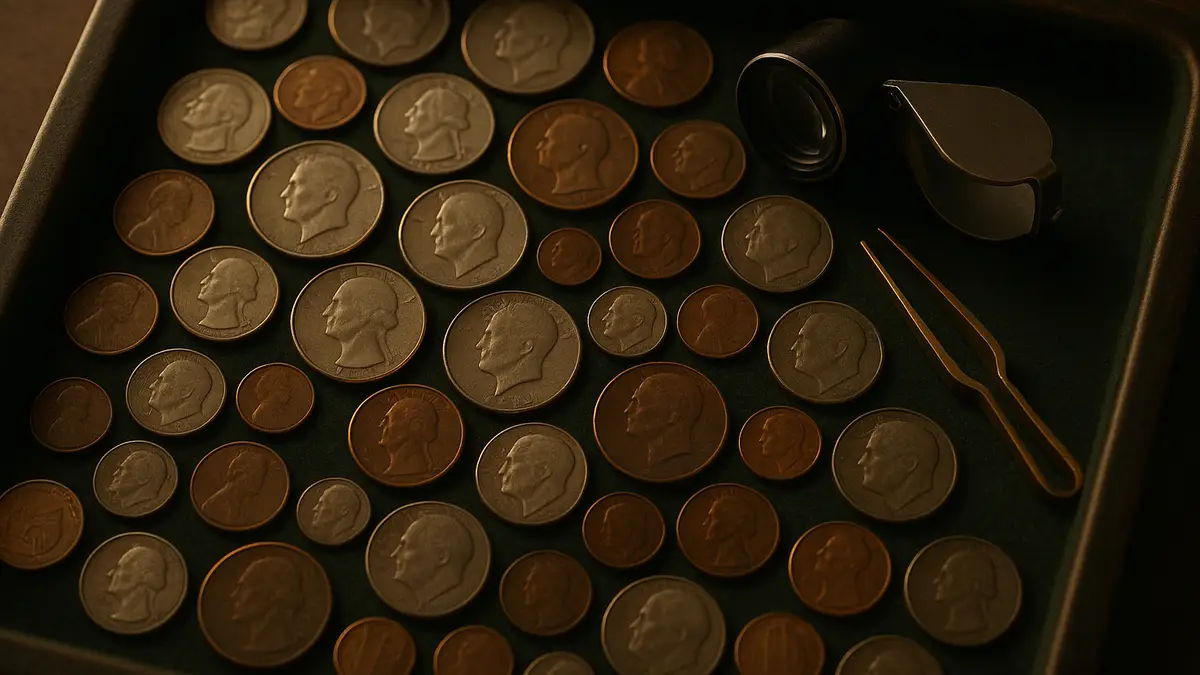
Someone hands you a jar of old coins and the first question is always the same: is any of this worth more than it says on the coin? Usually the answer is “a little,” occasionally it’s “a lot,” and this page shows you how to tell the difference before you dig into a specific date.
How do you check what an old coin is worth?
Start with three facts about the coin, not a gut feeling. First, the exact date and mint mark (a small letter, or no letter, near the date). Second, the metal, since anything silver is worth a floor value regardless of condition. Third, the wear level, because the same date can be worth $2 circulated and $40 uncirculated.
Mint marks matter because low-mintage branch strikes are often the scarce version of a common date. A blank space where a mint mark should be is its own clue on certain years; our mint marks guide explains how to read one on a worn coin.
Which coin series are worth checking?
Some series are worth a careful look at every date; others are worth checking only for a handful of key years. This table sorts the major US series by how often a valuable coin turns up in ordinary change or an inherited jar.
| Series | Date range | What makes it valuable | Typical circulated range |
|---|---|---|---|
| Wheat penny | 1909-1958 | Copper composition, key dates, doubled dies | $0.05-$0.15 common, $500+ key dates |
| Buffalo nickel | 1913-1938 | Low-mintage branch strikes, strong strike | $2-$5 common, $500+ key dates |
| Pre-1965 dime/quarter/half | through 1964 | 90% silver content | Silver melt floor and up |
| 1943 steel penny | 1943 only | Wartime zinc-coated steel, novelty | $0.10-$0.50 common |
| Morgan/Peace dollar | 1878-1935 | Large silver content, collector demand | $22-$35 common |
| Kennedy half dollar | 1964-present | 1964 is 90% silver, 1965-1970 is 40% silver | $3-$10 depending on year |
Which coins are worth the most searching for?
Three groups get searched constantly because they are common enough to actually find and valuable enough to matter. The 1964 American quarter sits at the very edge of the silver-to-clad cutoff, so it comes up first in almost every jar. The 1945 wheat penny is a workhorse date from the last full wartime production year. The 1937 buffalo nickel is common in circulated grades but hides a genuine five-figure key date in one mint mark variety.
Those three pages go deep on grading and mint marks for their series. Everything else on this site branches off from one of them.
Does silver content change the value?
Yes, and it is the single most reliable value floor on this site. Every dime, quarter, and half dollar struck for circulation through 1964 is 90% silver, which means it is worth at least its metal content no matter how worn it is. Coins from 1965 onward switched to a copper-nickel clad sandwich with no silver, except Kennedy half dollars, which stayed 40% silver through 1970 before also going clad.
That silver floor moves with the spot price of silver, so a fixed dollar figure goes stale fast. Our silver melt value calculator uses the coin’s actual silver weight and today’s spot price to give a current number instead of a guess pinned to an old market.
How much does condition change the price?
More than most people expect. A worn common-date coin and a sharp, lustrous example of the same date can sell for ten times apart, because condition is what collectors are actually paying for once a date is common enough to find easily. A 1937 buffalo nickel that has circulated for decades and lost most of its design detail might bring $2 to $5. The same date with full mint luster and crisp lettering can bring $15 to $30, and that gap only gets wider as you move up the scale.
The grading scale runs from Poor (barely identifiable) through Very Fine (moderate wear, most detail visible) to Mint State (no wear at all, judged on strike and surface quality). Learning to place a coin on that scale, even roughly, does more for your estimate than knowing ten more dates.
What is a “collector-market value range” and why not a single price?
A collector-market value range is the price band a coin realistically sells for based on recent sales of similar coins in similar condition, not a fixed number pulled from an old catalog. This site states ranges instead of single prices because two coins with the same date can sell for very different amounts depending on strike quality, surface marks, and eye appeal, none of which show up in a simple lookup. Every value on this site is a collector-market estimate, not investment advice or a guaranteed sale price.
What should you do once you know a coin’s value?
Grading comes before pricing. A coin’s date and mint mark tell you which price bracket it could fall into; its condition tells you where in that bracket it actually lands. Our coin grading basics guide walks through the 1-70 scale in plain terms, using wear location instead of jargon.
Once you have a grade and a realistic range, selling is a separate decision with its own tradeoffs between speed, price, and effort. eBay sold listings show real recent prices, a local coin shop offers instant cash at wholesale, and a coin show puts you in front of buyers who specialize in exactly what you have. The how to sell old coins guide breaks down which option fits which situation, so you are not guessing twice: once on value, and again on where to sell it.
Frequently asked questions
Quick answers to what readers ask us most
How do I know if an old coin is valuable?
Check three things in order: the date and mint mark, the metal (pre-1965 dimes, quarters, and half dollars are 90% silver), and the condition. A coin that is common, clad, and worn is worth face value. A coin that is a key date, silver, or uncirculated is worth checking against a current price guide.
What old coins should I actually check first?
Wheat pennies (1909-1958), buffalo nickels (1913-1938), and any dime, quarter, or half dollar dated 1964 or earlier. Those three groups account for most found-a-valuable-coin searches, and each has its own detailed guide linked below.
Are all old coins worth more than face value?
No. Age alone does not create value. Millions of common-date wheat pennies and pre-1965 clad-look coins exist, and most sit in the $0.05 to $5 range. Scarcity (low mintage, a key date, an error) and condition are what push a coin above melt or common-date pricing.
Where do I sell coins once I know what they're worth?
Once you have a realistic range, compare eBay sold listings, a local coin shop, and a coin show before committing. Our guide to selling old coins walks through the tradeoffs of each.