
Buffalo Nickel Value by Year: Complete Price Guide
See buffalo nickel value by year from 1913 to 1938, the real key dates like 1913-D and 1926-S, why so many are dateless, and how a 2005 buffalo nickel differs.
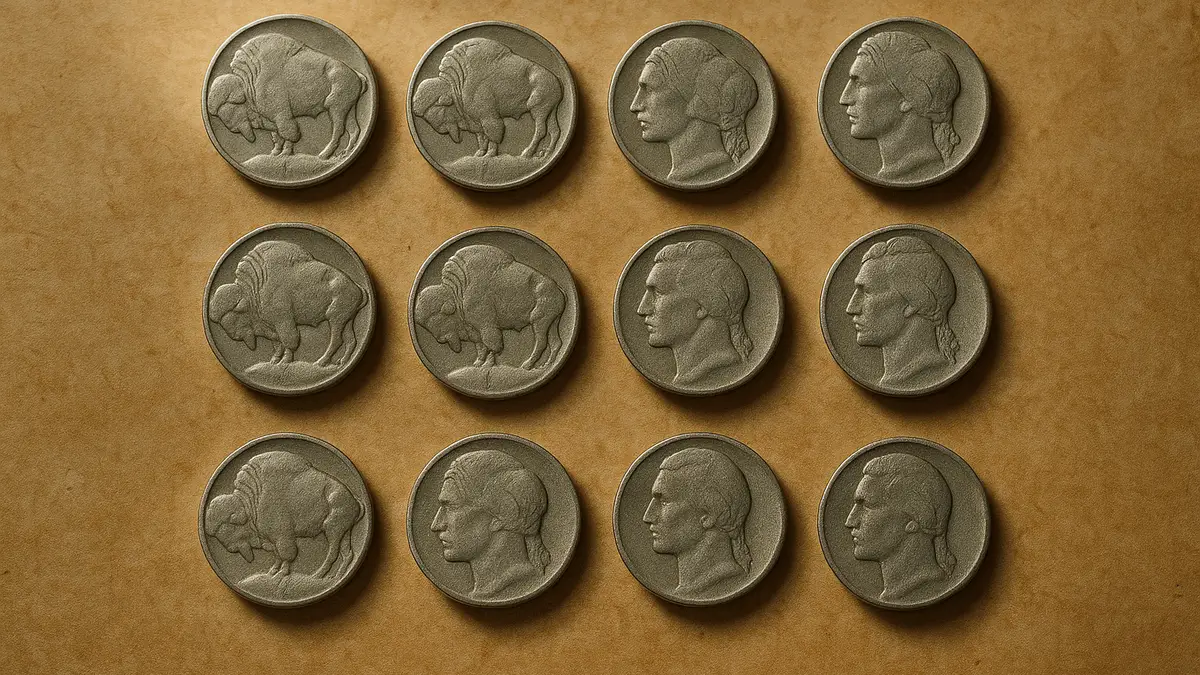
The buffalo nickel ran for just 25 years, from 1913 to 1938, and within that short window sits one of the most collected series in US coinage. Most dates are common, but the handful that are not stand out clearly once you know what to look for.
What is a buffalo nickel, and how do you tell it from other 5-cent coins?
A buffalo nickel shows a Native American portrait on the obverse and an American bison on the reverse, which is where the popular name comes from even though the coin’s official name is the Indian Head nickel. It replaced the Liberty Head nickel in 1913 and was itself replaced by the Jefferson nickel, which shows Jefferson’s portrait on the obverse and Monticello on the reverse, starting in 1938. If your coin shows a bison on the back, it dates to 1913-1938; if it shows a building, it is a Jefferson nickel from a later year.
What is a buffalo nickel worth by year?
| Years | What’s notable | Typical circulated value | Typical uncirculated value |
|---|---|---|---|
| 1913 Type 1 | Bison on raised mound, first design | $8-$15 | $60-$120 |
| 1913 Type 2, 1913-D Type 2 | Redesigned flat ground; 1913-D is a key date | $10-$20 common, $150+ for 1913-D | $75-$150 common |
| 1914-1917 | Common | $3-$8 | $25-$50 |
| 1918/7-D | Key date, overdate error | $600-$1,200+ | Extremely rare uncirculated |
| 1919-1925 | Common | $2-$6 | $20-$40 |
| 1926-S | Key date, low mintage | $50-$100 | Rare in uncirculated |
| 1927-1936 | Common | $2-$5 | $15-$30 |
| 1937 (standard) | Common; 1937-D three-legged is a key date | $2-$5, $500+ for three-legged | $15-$30 |
| 1938 | Final year, common | $2-$5 | $15-$30 |
These are collector-market ranges, not investment advice, and every figure assumes a coin free of damage or cleaning. Our 1937 buffalo nickel guide covers that specific year and the three-legged variety identification in more depth.
Why did the buffalo nickel design change partway through 1913?
The original 1913 design showed the bison standing on a raised mound, but that mound wore down quickly in circulation and took the FIVE CENTS denomination stamped on it along too, making worn coins hard to read for value. The mint corrected this within the same year by lowering the ground line to a flatter, recessed design and relocating FIVE CENTS to a less exposed spot. That short production window for the original Type 1 design, plus the shorter Type 2 run at the Denver mint before the year ended, is exactly why 1913 coins split into two distinct values depending on which type you have.
Which buffalo nickel years are the real key dates?
Four stand out clearly above the rest: 1913-D Type 2, struck in the redesigned style for only part of the year at the Denver mint; 1918/7-D, an overdate error where a 1917 die was reused and re-engraved with 1918 clearly visible over the old digit; 1926-S, a genuinely low-mintage San Francisco year; and 1937-D three-legged, the famous over-polished die error covered in detail in our 1937 guide. Each of these got that way for a different reason, low original mintage, a striking mistake, or a die error, which is why “old” alone never tells you whether a buffalo nickel is one of them.
Why do so many buffalo nickels have no visible date?
The date sits on one of the highest points of the design, which means it wears smooth faster than almost anything else on the coin. A buffalo nickel that circulated for decades often loses the date entirely, and once that happens there is no reliable way to confirm which year it actually is. A dateless buffalo nickel typically sells for well under a dollar, regardless of whether the underlying coin happened to be a common date or, unluckily, one of the four key dates listed above.
Is a 2005 buffalo nickel the same coin?
No, and this is a common mix-up. In 2005, as part of the Westward Journey Nickel Series commemorating the Lewis and Clark expedition, the mint issued special Jefferson nickel designs, including one reverse featuring an American bison. It is a genuine Jefferson nickel underneath, sharing the standard Jefferson-era composition and specs, not a continuation of the original 1913-1938 buffalo nickel series. It is a legitimate, collectible modern nickel, just not the same coin type as the ones in the table above. Our Jefferson nickel value by year guide covers that broader series, including the Westward Journey years.
How much does mint mark placement matter when checking a date?
Mint marks on buffalo nickels sit on the reverse, below FIVE CENTS and just to the right of the mound or ground line depending on the type. No letter means Philadelphia, D means Denver, and S means San Francisco. Because this spot is close to other high-wear areas of the design, a heavily circulated coin can lose a faint mint mark before it loses the date, which is the reverse of what happens on many other series. If a buffalo nickel shows a clear date but an unclear mint mark, magnification and good raking light usually resolve it, and that letter is worth confirming before you price the coin, since several of the key dates above depend entirely on which mint struck it.
What should you do next?
Sort by design first (bison reverse means pre-1939, building reverse means Jefferson series), then match your date against the table above before assuming a coin is either worthless or a hidden key date. Once you know what you actually have, our guide to selling old coins covers realistic paths for both a common-date jar and a genuine key date, since they sell best through very different channels.
Frequently asked questions
Quick answers to what readers ask us most
What is a 1936 buffalo nickel worth?
A common circulated 1936 buffalo nickel is worth about $2 to $5, and an uncirculated example can bring $15 to $30. 1936 was a high-mintage year late in the series with no widely recognized key variety.
What is the rarest buffalo nickel?
The 1913-D Type 2, the 1918/7-D overdate, the 1926-S, and the 1937-D three-legged variety are the most recognized key dates in the series, each selling for well above the common-date range due to genuinely lower surviving numbers or a striking error.
Is a buffalo nickel with no date worth anything?
Only a small amount, usually well under a dollar. The date sits on a high-wear point of the design, so many circulated buffalo nickels lose it entirely, and a dateless coin cannot be matched to a specific year, which caps its value regardless of what year it actually is.
Is a 2005 buffalo nickel the same as an old buffalo nickel?
No. A 2005 buffalo nickel is a Jefferson nickel from the Westward Journey series with a special American bison reverse design, not a coin from the original 1913-1938 buffalo nickel series. It shares the animal on the reverse but not the underlying coin type.