
Kennedy Half Dollar Value by Year: 1964-Today Chart
Kennedy half dollar values change sharply by year: 90% silver in 1964, 40% silver through 1970, then clad. See exact silver content and typical value by era.
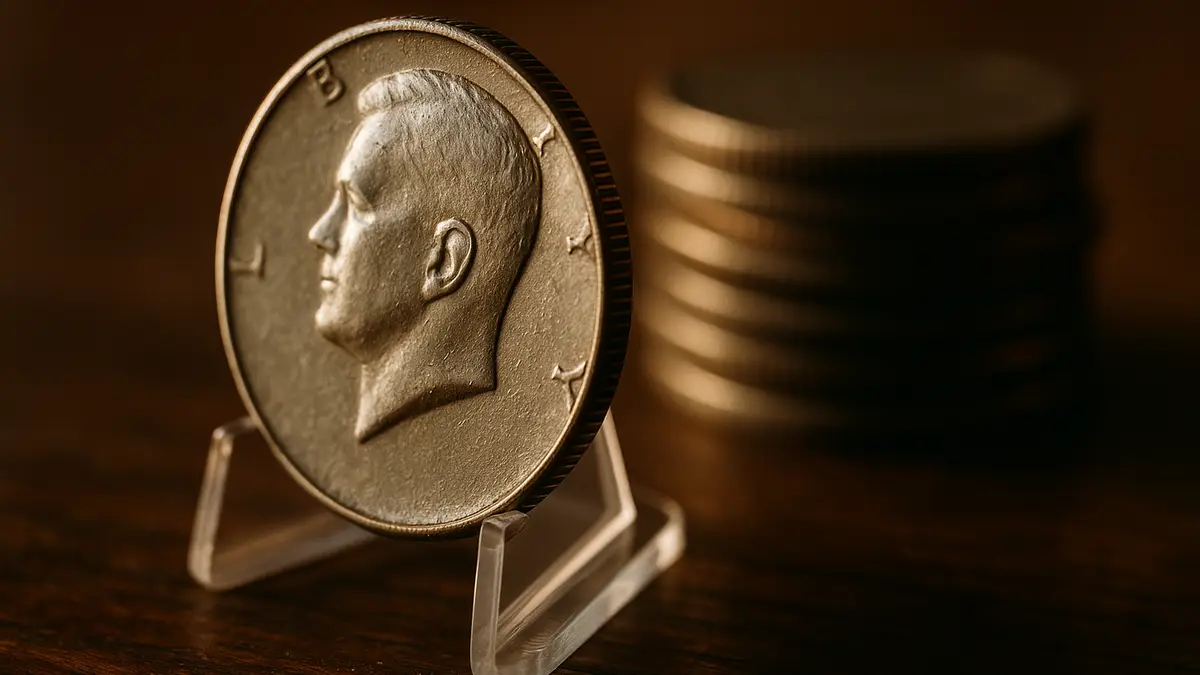
No US coin changed composition faster than the Kennedy half dollar. Three different alloys in less than a decade means the exact year on the coin decides whether it is worth face value or several times that, and the jump between years is sharp enough to matter.
Is a Kennedy half dollar silver?
It depends entirely on the year, with no gray area in between. 1964 is 90% silver. 1965 through 1970 is 40% silver. 1971 onward is copper-nickel clad with no silver at all. There is no gradual fade between these eras; the mint changed composition on a fixed schedule, so knowing the exact date is enough to know the metal.
What is a Kennedy half dollar worth by year?
| Years | Composition | Silver content | Typical value |
|---|---|---|---|
| 1964 | 90% silver | 0.3617 ozt | $6-$10 |
| 1965-1970 | 40% silver-clad | 0.1479 ozt | $3-$5 |
| 1971-present | Copper-nickel clad | None | Face value |
These are collector-market ranges based on silver near $28-$30 per ounce, not investment advice. For an exact current number rather than a range, run the coin through our silver melt value calculator, which recalculates using today’s spot price.
What is a 1964 Kennedy half dollar worth?
This is the year everyone asks about first, and for good reason. The Kennedy half dollar was rushed into production after President Kennedy’s assassination in late 1963 and released in early 1964 as a tribute coin, and it was struck in the same 90% silver standard used on quarters and dimes through that year. The public reaction was strong enough that many people saved their 1964 halves rather than spending them, which is part of why the coin remains relatively easy to find today despite the sentiment attached to it.
A 1964 half dollar weighs 12.50 grams and contains 0.3617 troy ounces of pure silver, the same silver weight as any other pre-1965 90% silver half dollar. At silver prices near $28-$30 an ounce, that puts a typical circulated 1964 half in the $6-$10 range, with uncirculated examples bringing more.
What is a 1965-1970 Kennedy half dollar worth?
Starting in 1965, the mint dropped the half dollar’s silver content to 40% rather than eliminating it outright, a middle step it did not take with dimes or quarters, which went straight to clad that same year. A 1965-1970 half weighs 11.50 grams and contains 0.1479 troy ounces of pure silver, worth roughly $3-$5 circulated at current silver prices. This range covers every year in the window equally, so a 1966 half dollar and a 1967 half dollar priced honestly land in the same range unless condition sets one apart.
What is a 1971-present Kennedy half dollar worth?
Face value, in almost every case. Starting in 1971, the mint moved the half dollar to the same copper-nickel clad composition used on quarters and dimes since 1965, removing silver from circulating half dollars entirely. A 1971, 1972, 1973, or 1974 half dollar you find in change or an old drawer is worth exactly 50 cents unless it is uncirculated, part of an original mint set, or carries a special reverse design like the bicentennial issue. Our 1976 bicentennial coin guide covers that specific exception, since the drummer, Independence Hall, and Liberty Bell designs from that year sit inside this same clad era but get asked about separately.
Why does the value drop so sharply after 1970?
The short answer is cost. Rising silver prices through the 1960s made even a 40% silver half dollar increasingly expensive for the mint to produce relative to its face value, and half dollars were already circulating less than other denominations, giving the mint less reason to keep any silver in them. Eliminating silver entirely in 1971 solved both problems at once, which is why the change from 1970 to 1971 is a hard line rather than a gradual phase-out.
Is any single year in the 1965-1970 window worth more than the others?
Yes, one stands out. 1970 Kennedy half dollars were not released for general circulation at all; that year, the mint struck them only for inclusion in official annual mint sets sold directly to collectors. That makes a 1970-D half dollar, the only mint mark that year, somewhat harder to find outside a set than 1965 through 1969 halves, even though it shares the same 40% silver composition and falls in the same general value range. A 1970-D half still in its original mint set packaging typically commands a premium over the plain melt-driven estimate in the table above.
How do you tell a 40% silver half from a clad one by looking at it?
It is harder than spotting a solid 90% silver coin, since the 40% silver alloy is itself a clad sandwich rather than solid silver, and the edge does not show the same obvious copper stripe a copper-nickel clad coin does. Weight is the more reliable test: a 40% silver half weighs 11.50 grams, while a post-1971 clad half weighs 11.34 grams, a small but measurable gap on a digital gram scale. When the difference is this narrow, checking the date first and using weight only to confirm is faster and more reliable than trying to judge composition by eye alone.
What should you do with a stack of Kennedy halves?
Sort by year first using the table above, since that alone tells you which coins carry real silver value and which do not. Once you have separated the 1964 and 1965-1970 coins from the post-1970 clad ones, our guide to selling old coins covers how to sell silver coins near melt value without accepting a lowball offer that assumes you do not know what you have.
Frequently asked questions
Quick answers to what readers ask us most
What is a 1964 Kennedy half dollar worth?
Roughly $6 to $10 in typical circulated condition, driven by its 90% silver content of 0.3617 troy ounces. It was the only year struck in this composition, since the mint switched to 40% silver starting in 1965.
Is a 1971 or 1972 half dollar worth anything?
Only face value in most cases. Every Kennedy half dated 1971 or later is copper-nickel clad with no silver content, so unless it is uncirculated or a special collector strike, it is worth exactly 50 cents.
What is a 1966 or 1967 half dollar worth?
About $3 to $5. Both years fall in the 1965-1970 window when Kennedy halves were struck in 40% silver rather than the original 90%, so they carry real but smaller silver value than a 1964 half.
Why did Kennedy half dollars stop having silver?
Rising silver prices made the metal in silver coins worth more than face value, so the mint reduced silver content to 40% in 1965 and eliminated it entirely starting in 1971. See our silver melt value calculator for current melt values on any silver-content coin.